|
|
9-27-2006 - Car and Driver
November issue - Colin feature


Of Brains and Brauns
America’s most hard-core racing family
produces one teenage driving savant and one teenage novelist.
BY JOHN PHILLIPS, PHOTOGRAPHY BY RICHARD DOLE
November 2006

The family Braun — parents Jeff and Diane, teenage sons Colin and Travis — live
atop a 200-foot-tall mesa, some 30 miles south of Abilene. Spread below their
100-acre parcel of pinyon, prickly pear, and mesquite is a mocha-colored valley
filled with longhorn cattle. Their view is unobstructed all the way to the next
West Texas mesa, 25 miles distant. The nearest neighbors are two miles off,
unless you count armadillos, white-tail deer, and rattlesnakes as neighbors.

The Brauns’ house is 185 feet long, a corrugated-metal
commercial building that looks like a garage because it is.
Beside it rests a black trampoline that was recently picked up by a tornado and
flung a football field away. From most angles, the property appears to have been
recently abandoned. The only sound is the rush of hot wind, so omnipresent that
a power consortium erected 35 wind turbines just north of the lot line. At
night, the towers’ blinking lights look like the red eyes of giant lobsters.
Inside are shock-absorber dynos, a machine shop, tools, and shelves filled with
go-kart parts and trophies. “Originally, this was my race-prep shop,” says the
head of the family, Jeff Braun. “Diane and I built it 18 years ago. Our boys
never lived anywhere else. We figured we’d build a real home elsewhere on the
property. Never got around to it.”
Instead, the Brauns live in 900 square feet of the shop. It
looks like the interior of a mobile home: three small bedrooms, one bath, and a
kitchen open to the living room. The furnishings are modest, save a 30-inch
flat-screen Sony that seems hard-wired to the Speed Channel. There’s no way to
watch TV without disturbing every occupant in the house. “But if it’s racing,”
says Jeff, “then that’s okay.”
Anyone brave enough to scale the Brauns’ locked gate and ascend their steep
third-of-a-mile gravel drive — a group that so far includes only the meter
reader and the FedEx guy — would likely surmise that these isolated occupants
are survivalists or hermits. They’d be wrong. One of the four Brauns — 135-pound
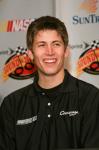
Colin — is quite a public figure. Fame befell his gangly, 17-year-old frame on
June 29, the day he co-drove a 500-hp Riley-Ford prototype to victory in the
Brumos 250 at Daytona, defeating such veteran grown-ups as Scott Pruett and Max
Angelelli. He thus became the youngest winner in Grand American Rolex Sports Car
Series history.
It’s tough to win any professional race and doubly tough
for Colin Braun (the family pronounces its name “brown”). When he flew to a
race, for instance, he wasn’t old enough to rent a car to get to the track. And
then he was banned from three Grand American races this season when occasional
weekend sponsor Philip Morris learned that a minor was competing in its events —
technically not a violation of the Master Settlement Agreement but close enough
to cause the jittery lawyers to bust open a pack of Marlboros. “I don’t smoke,
but it felt like I’d done something wrong,” Colin says. “When it happened, I was
tied for the points lead.”
When he was allowed behind the wheel, he struck a second blow for high-speed
precociousness, qualifying his Riley-Ford on the pole at Barber Motorsports Park
and bagging yet another win, along with co-driver Jörg Bergmeister.
The brain behind the Brauns is patriarch Jeff, 48, whose
unruly shock of gray hair has recently started to resemble white straw. He
graduated first in his class from the Milwaukee School of Engineering, then
quickly found his métier on the race team of boyhood friend and fellow
Wisconsinite (and 1992 Winston Cup champ) Alan Kulwicki. Running 60 races a
year, Jeff encountered racer after racer who’d beg for suspension-setup advice.
He obliged, evolving into what he now describes as a “fly-in engineer.” Since
then, he has teamed with a who’s who of driving aces — from Michele Alboreto to
Max Papis to NHRA Top Fuel driver Cristen Powell. He has prepped cars in IMSA,
CART, IRL, Winston Cup, Trans-Am, Grand American, and ALMS. And for many years
he was Andy Evans’s engineer, guiding the famously irascible owner’s Ferrari
333SP to a win at Sebring and a WSC title in ’95.
When he married Diane, Jeff promised she’d never be stranded at home — with good
reason: The Brauns are at racetracks or traveling to racetracks 220 days a year.
Colin attended his first speedfest — at Road Atlanta — when he was two weeks
old. On the road, the Brauns live in a $399,000 American Eagle motorhome,
covering 30,000 miles annually. “We’re gone so much,” says Diane, “it took me
years to figure out which pets I could keep back home. I tried hermit crabs for
a while. They died. Now I have an ant farm.”
Colin took a stab at kindergarten but missed 72 days, prompting a call from the
principal. “He said, ‘Ma’am, you better try home-schoolin’ your young’un,’”
Diane recalls. Since then, she has logged every single hour that Colin and his
brother, Travis, 16, have studied under her tutelage, although, she’s quick to
add, “by the time they were in the fifth grade, they were reading the textbooks
themselves.”
The teenage Brauns claim to miss “real” school not at all. “I’ve heard things
about gangs and shootings,” says Travis, who, at six foot one, is nearly three
inches taller than his older brother.
“Anyway,
all our friends were at the races,” adds Colin. “I didn’t know I was supposed to
be playing with the neighbor kids. I never knew who the neighbors were.
And then I had Travis to play with.”
When Colin turned four, he also had a Briggs & Stratton go-kart to play with,
a gift from his dad. “He raced it in the dirt around the house,” says Jeff, “lap
after lap, till it ran out of gas. I noticed he was making some interesting
steering corrections.”
“That’s my first memory of dabbling in motorsports on my own,” says Colin
today. “I remember that if I slid the tail around it would go faster, and I
liked to kick up rocks to hear them slap off trees. I’d find the groove and
steer the kart high, against the cushion. It would really go fast
there.”
When
the boys weren’t home schoolin’, they were behind-the-house schoolin’ — racing
on their private one-third-mile paved road course, which Jeff constructed in
1996, having wearied of the dust the boys were kicking up. He enlisted IMSA
Ferrari driver Fermín Vélez to help design the track — the hairpin is now the
Vélez turn — and the layout comprises a diabolical blend of esses and sweepers.
The course is configurable, with crossover points and turnarounds, as
challenging clockwise as counterclockwise. Jeff can further customize the track
by inserting hay bales, and he once even erected plywood walls along the berms
so Colin could sample a facsimile of a street course.
As the boys whizzed past at 65 mph, father Jeff would stand atop a 10-foot
scaffold and coach them via two-way radio. “I’d put out a pylon and say, ‘Make
sure your right-front tire touches that on every lap,’” he recalls. And he
organized formal drills. “First, I’d put Travis in front and have him do all
sorts of blocking, to see if Colin could stay patient until he found a way
around. And when he mastered that, we’d give him bad tires and say, ‘Now try to
get past.’” In the process, the boys learned how to “dump” each other — slowing
unexpectedly mid-turn, then suddenly standing on the gas. “The guy trailing is
caught by surprise,” explains Travis, “and he’ll overreact on his braking.”
Colin
began a routine of running 200 laps daily, pulling 2.00 g in several of the
turns, which not only strengthened his neck and arms but also taught him to cope
with the 100-degree Texas heat. “What I do is wear my Nomex suit, a plastic
raincoat, and an Eddie Bauer goose-down parka,” he says. “I do 45 minutes,
refuel, then another 45 minutes. I’ll lose three to five pounds like that. But
it’s really helped, because I’ve never had to wear a cool suit in a car.”

At one point, Colin’s regimen became so fanatical that he’d drive the kart at
night, navigating by moonlight alone. “I couldn’t see a turn till I was on top
of it,” he says. “It sharpened my reactions — made me concentrate on where I
was.” Sometimes he had to swerve to avoid deer, and he once nailed a sizable
bat. “That night,” he remembers, “I quit early.” And there are other creatures
he swerves to avoid. He points to a fist-sized gouge in one of the metal garage
walls. “Shotgun blast,” he says. “Big rattlesnake.”
As
Colin was racking up numerous go-kart championships, younger brother Travis gave
it a whirl, too, entering a race in Denton, Texas. He was only seven years old,
but he was also one of the Brauns. So he won. That unlikely victory, however,
induced the most minor of thrills. Travis was already nurturing a passion that
surpassed driving. “My father had equipped Colin’s quarter-midgets and karts
with a Pi data-acquisition system,” he explains. “I asked for a laptop to
download it. That really interested me. At first, I could read the data but not
analyze it — you know, couldn’t put it into context. But then Colin began racing
three or four different-class karts per weekend, so I began seeing a lot
of data, and I’d go to my father and say, ‘Look here, an aberration, an anomaly.
What does it mean?’”
“He got so he could confront Colin during practice,” Jeff remembers. “‘Oh,
Colin,’ he’d sort of purr sarcastically. ‘You’re lifting off the gas
again.’ And Colin would scream, ‘No way. I’m not!’ So Travis would show
him the traces.”
By the time he was 14, Travis had so honed his skills that he was hired by a
Star-Mazda team to download their data for a season. At age 15, he did the same
for one of Kevin Buckler’s Grand American GT Porsches. And for 2006, he is
working for SAMAX Motorsport, logging data from their Porsche 911 GT3. He
further distinguished himself at the Daytona 24 Hours, where he computed the
team’s pit strategies — fuel, tires, driver swaps — which he displayed on a
board he’d made himself. “I’d learned from Dad,” he says, “that you can’t have
guys always coming up to ask, ‘What do we do next?’ or ‘Do we pit or stay out?’”
If young Travis had apparently turned pro, his brother had long since made
the transition. “It was when Colin was almost 14,” his father recalls, “and I’d
hear him in his room, phoning suppliers and teams, trying to get an engine
program and a fully funded ride. Growing up at the track, he was comfortable
talking to adults. We had just spent 50 grand on his karting that year — and
that didn’t include my time — and Colin knew we’d need $120,000 for the next
step. So he was telling people what he could bring to the package, what they’d
get in return. Right then, I realized he wasn’t looking at this like a little
boy having fun. He considered it his living. Natural talent? Lots of kids have
that. What you also need is organizational skills and a view of the big picture.
By the end of his 13th year, Colin had developed that.”
The back-yard training sessions nonetheless continued. “In go-karts,” says
Jeff, “there’s no aero, no downforce. It’s all about that contact patch and how
well the driver feels it. When Colin came in, I’d say, ‘What was each tire
doing? Describe it to me exactly.’ Man, he got good at that.”
“There was one drill,” Colin remembers, “where I’d go out for 15 laps and
work the right-front tire real hard but save the left front. Or they’d put on
one crappy tire, and it was my job to figure out which it was.”
On the few occasions when Colin raced poorly, he learned not to blame the
machinery. “By then, if we missed the setup,” Jeff explains, “I’d say, ‘Well,
that’s 50 percent your fault. Good drivers describe problems before
the green flag. You didn’t do that. So you lose.’”
But
he didn’t lose often. In his 14th year, Colin raced a 102-hp Formula Renault,
his first drive in an actual car, not a kart. “You had to be 16 to race those,”
recalls Jeff, “so we explained his karting record, and they agreed to give him a
shot, but they gave me that look, like, ‘This ain’t gonna work.’ So we
showed up at Willow Springs for the first race — a track Colin had never seen
before — and he won. People were saying, ‘He must be cheating or
something.’”
Remarkably, Colin won eight of the next 11 races — races in which he was now
earning money instead of trophies — and that’s when the phone back home began to
ring. Colin raided his dad’s Rolodex and had no trouble booking “informal talks”
with Tracy Krohn, Robert Yates, Roger Penske, and Joe Gibbs.

“It’s no secret that my goal is Busch or Craftsman Truck, then
Nextel Cup,” Colin says. “Thirty races a year, 43 cars in every
field, the greatest possible seat time and action. That’s what I
want. But my philosophy is only to take a ride where I have a chance
to win. To run 20th in a Cup car every week, well, maybe I’d make a
good living, but I’d rather stay in pro sports cars and win two or
three races a year.”
Now in his final year of home schooling, Colin is contemplating
college but worries it might derail his racing. “Ryan Newman earned
a degree while he was driving,” Colin says, “so maybe I could, too.
I need to learn the business side — negotiating contracts,
investing, creating budgets. Wayne Taylor [2005 Grand American
champ] helps me with that stuff now.”
For his part, brother Travis harbors exactly zero
doubt about college, having made another 90-degree turn in his
career. “What happened was, I went crazy over [novelist] John
Grisham,” he says. “I read every book he ever wrote. And now it’s
like I want to be John Grisham.” In this latest passion, Travis has
immersed himself in typical Braun fashion, self-publishing a novel
called The Silent Shadow. Now he’s putting the finishing touches on
a work he calls The Secret Suspect, a “mystery novel in the Hardy
Boys vein,” he says. Not long ago, his byline appeared in Formula
Car magazine, and he’s had business cards printed that read, “Travis
Braun, Freelance Novelist/Journalist.” His next goal: a journalism
degree from Indiana’s Franklin College.
With two teenagers so maniacally focused and presciently capable,
Jeff and Diane are occasionally accused of being “sports parents,”
in the manner of Tiger Woods’s father and Jimmy Connors’s mother.
“I’m not offended by it,” Jeff replies, “but it isn’t true. We never
had a master plan like ‘Let’s create the next Ayrton Senna.’” But
the question still gets asked: Which came first, Colin’s passion for
racing or observing his successful dad at the track 220 days per
year? And even if Colin possesses vast talent as a wheelman, it
helps to have had his own racetrack and a father capable of
preparing cars to win at any level of motorsports, a father on a
first-name basis with the bulk of America’s wealthiest owners.
Because Colin has been exposed to no other career opportunities, a
case could be made that he has reflexively followed the lone path
laid before him.
“All I can tell you,” Jeff says, “is that Diane and I don’t want to
be his agent, his manager, his handler, his PR guy — none of that.
It was always Colin who came to us and said, ‘Can’t I do more
racing?’ When he makes a career move, we talk about it over dinner,
then I advise him to ask Wayne Taylor. In my defense, I point to my
other son and say, ‘Hey, I’m the world’s worst speller and have
trouble stringing a decent sentence together, so there’s no way I
forced Travis’s particular passion.’ Both boys are on career paths
that I’m hugely proud of. Speaking strictly as a parent, how bad is
that?”
Until Travis leaves for J-school, the family Braun will remain
intact — Jeff as the engineer for Tracy Krohn’s Riley-Ford Daytona
Prototype, Colin co-driving the second Krohn prototype, Travis
logging data for the SAMAX Porsche, and Diane preparing hundreds of
hot meals for what she calls “the three best men on earth.” And
during the 145 or so days that the Brauns manage to sneak back to
their windy Texas mesa, peace prevails. “For vacation,” Jeff
confesses, “we tell people we’re in Hawaii or something, but we
secretly come here and take the phone off the hook. The boys run the
karts, we shoot traps, and we grill steaks over our own mesquite.”
“I get enough of the crush of people and noise at the races,” adds
Colin. “Being home always feels like a reward.” Neither he nor
Travis will mosey into Abilene to flirt with girls or feed quarters
into video games or hang out at the mall. Neither, in fact, owns a
car or even wants one, although Colin, who is said to be earning
$75,000 to $100,000 this year, could afford quite a fancy ride.
“Sometimes I’ll drive Mom’s Expedition to help her get groceries,”
he says. “Otherwise, I don’t like to leave the property. Travis and
I just ride our bikes and ATVs on trails, and we have a big movie
collection. Late at night, the four of us pick a movie, then Mom
lays ’em on the table and rolls the dice. Whoever’s number comes up
first, that’s the movie we watch. We’ll go to bed at maybe 3 a.m.
and get up at 11.”
“Okay, so we’re a little weird,” Jeff concedes.
Nowadays, the elder Brauns sometimes discuss retirement. “When that
day comes,” Jeff warns, “all I want to do is watch Colin race — not
participate — then drive the motorhome to Travis’s book signings.”
“Hah!” cracks Colin, standing in the doorway to the windowless
cubbyhole that is his bedroom. “Never happen. He’s a total action
junkie. Can’t keep his hands off.”
 |